Best Part 107 study materials
Part 107 is a real proctored exam, not a form to fill out. The right study material depends on how much aviation background you are starting with.
Researched from published specifications and verified owner reviews · updated 2026
The short answer
The Part 107 knowledge test is 60 questions with 70 percent required to pass, taken in person at an FAA-approved testing center, and the ASA Remote Pilot Test Prep book is the structured study material most flight schools hand out to prepare for it.
For most people preparing to sit the exam, the ASA Remote Pilot Test Prep is the right starting point, the same structured book most flight schools hand new students, organized by knowledge area with a question bank built to mirror the real test. Anyone who has never read a sectional chart or an airspace diagram before often does better starting with the plainer Drone FAA 107 License Study Guide to build the underlying concepts first.

ASA
ASA Remote Pilot Test Prep
Paperback plus practice software
The same structured test prep book most flight schools hand new students, organized by the exact knowledge areas the exam draws from.
Prices move constantly. We earn a commission if you buy through these links, at no extra cost to you.
How hard is the Part 107 exam, really?
Part 107 is a genuine proctored exam, not a self-certifying quiz. It is 60 multiple-choice questions, you need 70 percent correct to pass, which is 42 correct answers, and you take it in person at an FAA-approved knowledge testing center rather than online at home. There is a fee to sit it, and that fee changes over time, so treat any specific number you read, including on this page, as something to confirm at faa.gov/uas before scheduling. Once you pass, the certificate does not expire outright, but you must complete recurrent training every 24 calendar months through an FAA-accepted online course to remain legally current to exercise the privileges of it.
How TRUST is different, and why the two get confused
TRUST, the recreational flyer test, gets confused with Part 107 constantly because both involve an FAA knowledge requirement and both use the word test. The similarity ends there. TRUST is free, it cannot be failed since you simply keep answering until you complete it correctly, and the certificate it produces cannot be reissued if lost, meaning a lost TRUST certificate means retaking the whole test from scratch rather than requesting a replacement. Part 107 is the opposite on every point: it has a real pass threshold you can fail, it costs a fee, it is proctored in person, and it requires ongoing recurrent training to stay current. Flying for work, for a client, or in furtherance of a business of any kind requires Part 107 specifically. TRUST never substitutes for it, no matter how informal or unpaid the commercial work is. Our TRUST test guide covers the recreational side in full, and Part 107 versus recreational rules lays the two paths side by side.
How did we choose these study materials?
We do not sit these exams ourselves and are not claiming to. This comparison is built from what each publisher states the book actually contains, checked against the FAA's published knowledge area list for the current exam, and against verified reviews from people who used each book to prepare and reported whether the practice questions matched the real exam's style and difficulty. Where reviewers disagreed on how current a given edition was, we noted the disagreement rather than picking a side.
Study materials by where you are starting from
A newcomer, someone ready to drill practice questions, and someone who has already passed each need something different.
Independently published
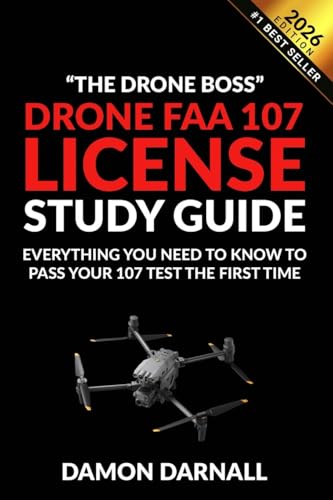
Drone FAA 107 License Study Guide
Plain-language study guide
Sectional charts, airspace classes and weather symbols are entirely new to you and you want the concepts explained before the drilling starts.
A plainer companion to the ASA book. Useful if sectional charts and airspace diagrams are entirely new to you and you want the concepts before the drilling.
ASA
ASA Remote Pilot Test Prep
Paperback plus practice software
You want the same structured test prep most flight schools hand out, organised by knowledge area with a question bank matched to the real exam.
The test-prep book most flight schools hand out, organised by knowledge area with a question bank that mirrors the real exam structure.

ASA
ASA Standard UAS Operator Logbook
Paper logbook, flight and maintenance
You have already passed the exam and need a flight and maintenance record that clients, insurers and the FAA can all point to.
A flight log is not required for Part 107 but every commercial client and insurer eventually asks for one. Ten dollars now beats reconstructing a year later.
Prices are approximate and change constantly. Links are affiliate links: we earn a commission if you buy, at no extra cost to you.
The ASA Standard UAS Operator Logbook is not something to buy before you have passed the exam. It is a post-certification tool for tracking flight hours, aircraft maintenance and incident records once you are flying commercially, and buying it while you are still studying for the knowledge test puts money toward a problem you do not have yet. Spend that budget on practice questions instead until you have your certificate in hand.
TRUST versus Part 107 at a glance
| Requirement | TRUST (recreational) | Part 107 (commercial) |
|---|---|---|
| Who needs it | Recreational flyers, flying purely for fun | Any flight for work, a client, or a business, paid or not |
| Cost | Free | A fee applies, verify the current amount at faa.gov/uas |
| Format | Online, self-paced, ungraded pass path | 60 questions, in person, proctored at an approved center |
| Can you fail it | No, you continue until every question is answered correctly | Yes, below 70 percent correct is a fail |
| If you lose the certificate | Cannot be reissued, retake the whole test | Certificate can be replaced through the FAA |
| Ongoing requirement | None | Recurrent training every 24 calendar months |
What actually trips people up on the exam
Reading a sectional chart and correctly identifying airspace classification is, by a wide margin, the section newcomers with no aviation background struggle with most, because it is the one area that requires learning an entirely new visual language rather than applying common sense to a drone-specific rule. Weather source interpretation is the second most common weak spot, since it draws on aviation weather products that most people have never encountered outside the test. Regulations, loading and performance, and emergency procedures questions tend to be more intuitive once you understand the underlying reasoning, which is exactly why a structured guide that explains the reasoning outperforms flashcards that only state the rule. Our what Part 107 actually covers and reading a sectional chart guides both go deeper on the sections people ask about most.
Building an actual study plan
Most people preparing for Part 107 without a flight-school course budget somewhere between two and six weeks of part-time study, working through each knowledge area once, then drilling practice questions until scores are consistently well above the 70 percent threshold rather than just scraping past it. A book that pairs explanation with a practice question bank in the same style as the real exam, like the ASA Remote Pilot Test Prep, lets you do both from one source instead of hunting for separate practice questions online. Our how to study for Part 107 guide lays out a week-by-week structure, and practice questions gives a free sample set to gauge where you stand before committing to a full study plan.
What to expect on exam day
Arriving prepared for the logistics of test day matters almost as much as the studying itself. Testing centers require a valid government-issued photo ID that exactly matches the name used to register for the exam, and most centers do not allow personal items, phones or notes into the testing room, storing them in a locker instead. The exam is computer-based and untimed pressure is lower than it sounds since candidates are given two hours to complete 60 questions, which is generous relative to the actual time most prepared candidates need. Results are typically available immediately after finishing, and a passing score triggers the paperwork to apply for the actual Remote Pilot Certificate through the FAA's online system, which is a separate step from sitting the exam itself and involves its own processing time.
Free FAA resources worth using alongside a paid book
A paid study guide is not the only source, and the strongest preparation usually combines one. The FAA publishes its own Airman Certification Standards document, which lists every knowledge area and task the exam actually draws from in the FAA's own language, and it is worth reading once alongside a commercial study guide to see how closely the guide's chapter structure maps to the official standard. The FAA also publishes sample question sets and a study supplement covering sectional chart symbols in detail, which pairs well with the practice questions in a book like the ASA Remote Pilot Test Prep for a second angle on the same material rather than relying on one source's phrasing alone.
What happens if you do not pass on the first attempt
A failing score is not unusual and does not carry any lasting penalty beyond the retest itself. Current policy requires a waiting period of fourteen calendar days before retesting, and there is no limit on how many times you can retake the exam within that structure, though each attempt typically requires paying the testing fee again. The most useful thing to do in that fourteen-day window is not simply rereading the same material, but going back through a practice question bank like the one in the ASA Remote Pilot Test Prep and specifically drilling the knowledge areas where you scored weakest, since the score report from a failed attempt breaks results down by category and tells you exactly where to focus.
Buying tips
- Check the edition date before buying. Knowledge areas and question emphasis shift over time, and a study guide more than a couple of years out of date can drill outdated details alongside the parts that never change.
- Prioritize a book with a real practice question bank over one that is explanation only. Recognizing the exam's specific question phrasing under time pressure is a separate skill from understanding the underlying rule.
- Do not skip sectional chart practice even if it feels tedious. It is consistently the section that costs newcomers the most points, and it rewards repetition more than any other section.
- Schedule recurrent training before the 24-month deadline, not after. Track the date your certificate was issued and put a reminder well ahead of the two-year mark, since letting it lapse means you are not current to fly commercially until it is completed.
- Buy the logbook once you pass, not before. It is a good habit to start from your very first commercial flight, but it solves a problem that only exists after certification.
Once certified, our recurrent training guide covers exactly what the 24-month refresher involves, and the full Part 107 hub is the starting point for waivers, what the certificate actually lets you do, and how it compares to recreational rules in more detail.
Questions people ask
+ How many questions are on the Part 107 exam and what score do I need to pass?
The Part 107 knowledge test is 60 multiple-choice questions, and you need to answer 70 percent correctly to pass, which is 42 correct answers. It is taken in person, proctored, at an FAA-approved knowledge testing center, and there is a fee to sit it that changes over time, so confirm the current amount at faa.gov/uas rather than relying on a fixed figure from any single source.
+ What is the difference between the Part 107 exam and the TRUST test?
TRUST is the free recreational flyer knowledge and safety test. It cannot be failed: you keep answering until you complete it correctly, and the certificate cannot be reissued if lost, meaning you retake the whole test to get a replacement. Part 107 is a real proctored exam with a pass threshold, a fee, an FAA-approved testing center, and it requires recurrent training every 24 calendar months to stay current. They serve entirely different purposes and neither substitutes for the other.
+ Do I need to retake the Part 107 exam every two years?
Not the full knowledge test, but you do need to complete recurrent training every 24 calendar months to keep your certificate current, using an FAA-accepted online training course rather than sitting the original in-person exam again. Letting the recurrency lapse does not cancel the certificate outright but does mean you are not legally current to exercise the privileges of it until the training is completed.
+ Is a paid study guide actually necessary, or can I study for free?
Free FAA study material exists and is accurate, but it is written as reference material, not as a guided course, which makes it a harder starting point for someone with no aviation background. A structured guide or test prep book organizes the same knowledge areas into a study order, explains the reasoning behind sectional chart and airspace questions rather than just stating rules, and includes practice questions written in the same style as the real exam.
+ What knowledge areas does the Part 107 exam actually cover?
The exam draws from regulations governing small unmanned aircraft operations, airspace classification and operating requirements, aviation weather sources and effects, small UAS loading and performance, emergency procedures, crew resource management, radio communication procedures, physiological effects of drugs and alcohol, aeronautical decision-making, airport operations, and maintenance and preflight inspection. Sectional chart reading and airspace classification questions are the sections newcomers with no aviation background typically find hardest.
+ Do I need a logbook if Part 107 does not require one?
A written flight log is not a formal Part 107 requirement, but in practice nearly every commercial client, insurance policy and incident investigation eventually asks for one, and reconstructing a year of flights from memory after the fact is far harder than logging them as you go. A paper or digital logbook costs little compared to the professional credibility and liability protection it provides once you are flying commercially.