Thrust to weight and hover throttle calculator
The one number that predicts whether a build will feel sluggish, right, or unflyable.
Researched from published specifications and verified owner reviews · updated 2026
The short answer
Thrust to weight ratio is total maximum thrust from all motors divided by all-up takeoff weight. A multirotor needs at least 2 to 1 to fly safely, roughly 4 to 1 for responsive freestyle, and 8 to 1 or more for racing. Hover throttle should land between 35 and 50 percent, with about 40 percent being ideal.
Thrust to weight ratio is total maximum thrust divided by all-up takeoff weight. It is the single most predictive number in a multirotor build, because it determines not just how fast the aircraft accelerates but how much authority it has left to recover when something upsets it. A quad with nothing in reserve is not slow, it is fragile.
iFlight
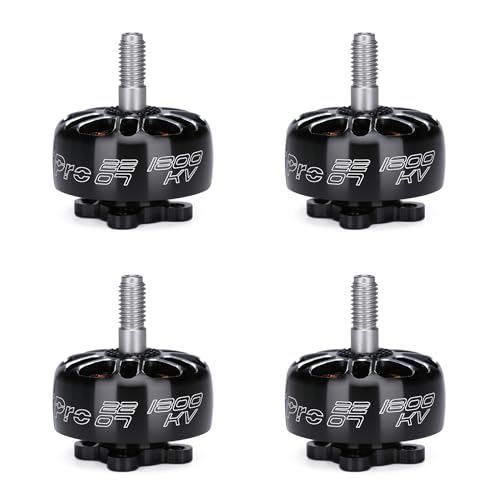
iFlight XING-E Pro 2207 1800KV motors (4 pack)
2207, 1800KV, 6S
2207 at 1800KV on 6S is the settled default for a 5 inch freestyle build, which means published thrust data, props and tuning advice all assume it and your numbers will match other people's.
Prices move constantly. We earn a commission if you buy through these links, at no extra cost to you.
Build check
Thrust to weight and hover throttle
Use the per-motor thrust from the manufacturer's chart for your exact motor, propeller and cell count. Thrust figures do not transfer between cell counts or propellers.
Hover throttle is estimated from a square-law thrust curve, which is a good approximation and not an exact model of any particular motor. Manufacturer thrust figures are measured on a bench with a fresh pack and no airframe interference, so a real build typically delivers slightly less. Researched from published thrust data, not from testing.
Why 2 to 1 is the floor
At exactly 1 to 1 the aircraft can hold itself in the air at full throttle and do nothing else. At 1.5 to 1 it can climb slowly and cannot recover from a strong disturbance, because recovering means commanding extra thrust on two motors while the other two are already near their limit. At 2 to 1 it hovers around 70 percent throttle, which is workable and leaves the motors running hot.
That is why 2 to 1 is a floor rather than a target. The number you actually want is set by what you are building, and the throttle position where the aircraft hovers is a better guide than the ratio itself, because throttle position is what you feel on the sticks.
| Build type | Thrust to weight | Hover throttle | Character |
|---|---|---|---|
| Endurance or mapping platform | 2.0 to 2.5 : 1 | 63 to 70% | Stable, long flights, slow to respond |
| Camera drone, consumer folding | 2.2 to 3 : 1 | 58 to 67% | Calm, holds position, limited gust reserve |
| Cinewhoop or cinelifter | 2.5 to 3.5 : 1 | 53 to 63% | Enough to lift a camera, deliberately smooth |
| Freestyle 5 inch | 3.5 to 5 : 1 | 45 to 53% | Responsive, controllable, the usual target |
| Aggressive freestyle | 5 to 8 : 1 | 35 to 45% | Snappy, punishing on props and frames |
| Racing | 8 to 12 : 1 | 29 to 35% | Extreme acceleration, compressed control band |
Where thrust numbers come from, and where they lie
Motor manufacturers publish thrust charts: for each motor, propeller and cell count, a table of thrust, current and efficiency at each throttle step. Those are the numbers to use, and there are three ways to misread them.
Cell count matters enormously. A 2207 motor that produces 1,450 g on 6S produces roughly 950 g on 4S, because thrust scales with the power available. Never carry a figure from one cell count to another.
The propeller matters as much as the motor. The same motor on a 5 inch tri-blade and a 5 inch bi-blade produces meaningfully different thrust, current and efficiency. Use the row for the propeller you will actually fit, whether that is a set of Gemfan 51466 V2 three-blade props (20 pack) ($18) or something else.
Bench numbers are optimistic. A thrust stand measures a motor in clean air with a fresh pack. On a real airframe the arms, the frame and the neighbouring propellers all disturb the airflow, and by the end of a pack the voltage has sagged. Expect a real build to deliver somewhat less than the chart.
Weight is the lever you actually control
You cannot easily change published motor thrust, but you can change what the aircraft weighs, and weight is where builds go wrong. Builders add a GPS module, a bigger antenna, a second video transmitter, an action camera mount and a heavier pack, each of which is trivial, and then wonder why the quad flies like a brick.
Weigh the assembled aircraft with the pack strapped on. Adding up component specifications reliably understates the total by 30 to 60 g once you count wire, solder, heat shrink, foam and the battery strap. The calculator's max-weight output tells you how much you have to play with before you fall below your target ratio.
Thrust to weight on a camera drone
Consumer camera drones are deliberately built low on this scale, because endurance and thrust reserve are in direct competition and manufacturers sell on flight time. The consequence is the one every pilot notices: sub-250 g aircraft get pushed around in wind that a heavier aircraft flies through calmly, and that is partly inertia and partly thrust reserve.
It is also why fitting accessories to a light aircraft is worse than it looks. Adding 40 g to a 249 g airframe does not just cost endurance, it eats into a thrust reserve that was already thin. Quantify both with the flight time calculator and the weight and registration tool, and check what conditions the result can actually handle with the wind margin calculator.
Turning the number into a build
Once the ratio works, the next question is whether the motor, propeller and cell count are a sane combination, which is the propeller and motor matching calculator. Then the parts list itself: the components that make up a first 5 inch build are in best FPV build parts, the assembly order is in the first build walkthrough, and a complete priced build is the 5 inch freestyle build.
Questions people ask
+ What thrust to weight ratio does a quadcopter need?
A minimum of 2 to 1 to fly safely, 4 to 1 for a responsive freestyle quad, and 8 to 1 or more for racing. Below 2 to 1 the aircraft has no authority to recover from a disturbance and hovers at a throttle position where the motors are already working hard. A camera drone designed for endurance typically sits between 2 and 2.5 to 1, which is why it feels stable rather than snappy.
+ What throttle should a quad hover at?
Between 35 and 50 percent is the range most builders aim for, and roughly 40 percent is the sweet spot on a freestyle quad. Hovering much above 50 percent means the build is underpowered or overweight and has little left for a hard climb. Hovering below 30 percent means the throttle curve is compressed into a small band at the bottom, which makes fine control difficult.
+ How do I find the thrust of my motor and propeller?
From the manufacturer thrust chart for that exact motor and propeller combination at your cell count. Reputable motor makers publish tables of thrust, current and efficiency at each throttle step. A motor rated for a given thrust on 6S will produce roughly a third less on 4S, so never carry a figure across cell counts, and always use the number for the propeller you actually intend to fit.
+ Is more thrust always better?
No. Thrust costs current, weight and efficiency. A very high ratio gives brutal acceleration and short flights, and it puts a lot of stress on a frame and on props. For freestyle and cinematic work, roughly 4 to 1 with a smooth throttle response is a nicer aircraft to fly than 9 to 1 that is twitchy off the bottom of the stick. Match the ratio to the flying you actually do.
+ Does thrust to weight matter on a camera drone?
It matters for wind, not for acrobatics. A camera drone with more thrust in reserve holds position better in gusts, because correcting for a gust means momentarily commanding more thrust on the windward motors. That is one reason heavier prosumer aircraft feel calmer in wind than sub-250 g aircraft, which have both less inertia and a lower thrust reserve.
+ What all-up weight should I use in the calculation?
Everything at takeoff: frame, motors, stack, camera, video transmitter, receiver, antennas, GPS, straps, the battery and any action camera. Builders routinely forget the battery, which on a 5 inch quad is roughly a quarter of the total. Weigh the assembled aircraft with the pack strapped on rather than adding up component specifications.