Drone Pilot Field Kit
What actually lives in the bag, organized so nothing gets left in the car.
Researched from published specifications and verified owner reviews · updated 2026
The short answer
A complete drone pilot field kit covers five categories: power (batteries, charger, power bank), spares (props, screws), data (memory cards, reader, storage), tools (hex drivers, cleaning gear) and compliance documents (TRUST or Part 107 proof, insurance).
A well-packed field kit is the difference between a flying session that runs smoothly and one interrupted by a problem that a two dollar spare part would have solved. This is the kit experienced pilots actually carry, organized by category rather than as a random list, so you can check it quickly before leaving home instead of discovering a gap at the site.
Pelican
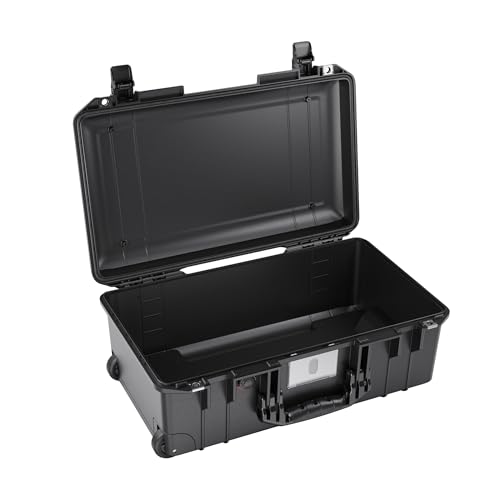
Pelican Air 1535 case (no foam)
Carry-on size, IP67, no foam
Carry-on legal on most airlines, watertight, and sold without foam so you cut or buy an insert to fit whatever your kit becomes as it grows.
Prices move constantly. We earn a commission if you buy through these links, at no extra cost to you.
What actually goes in the bag versus what stays in the car
Not everything in a full field kit needs to ride on your back for every flight. A reasonable split separates items into a core carry, what actually goes into a shoulder bag or hip pack for a walking session, and a vehicle reserve, bulkier or heavier items kept in the car and grabbed only when a specific job calls for them. Core carry typically covers two to three batteries, one spare prop set, a single memory card and reader, TRUST or Part 107 proof, and basic tools. The vehicle reserve covers the larger power bank, additional spare batteries beyond the core carry count, the hard case itself if flying from a fixed nearby location rather than hiking to the site, and any job-specific accessories like ground control targets or a thermal camera. This split keeps a casual walking session light while still having the full kit available within a short walk back to the vehicle for anything longer or more demanding.
Power: the category that decides how long you actually fly
Beyond the aircraft's own packs, a charging hub like the DJI 30W USB-C Two-Way Charging Hub lets you cycle multiple batteries from a single cable while flying on another, which turns limited battery count into a real session rather than a series of short waits. A portable power source, either an Anker 737 power bank (140W, 24,000 mAh) for a compact day kit or a Jackery Explorer 300 portable power station for a full day with no outlet access, keeps that charging cycle going without needing to find power on site. A cheap 1-8S LiPo cell checker with low-voltage alarm is worth the pocket space to verify an older pack's per-cell health before trusting it on a flight that matters.
Spares: the cheap items that prevent an expensive scrub
Propellers are consumables and deserve at least one full spare set in every kit, matched to your specific aircraft, such as the Low-noise propellers for Mini 3 and Mini 4 Pro (24 pack) or Low-noise propellers for Air 3 and Air 3S (8 pack) depending on what you fly. A small set of Titanium hex driver set (1.5 to 3.0 mm) covers prop changes and most accessory mounting, and a folding 30 inch waterproof folding landing pad protects the aircraft's sensors and motors on dusty or uneven ground.
| Category | Item | Why it is in the bag |
|---|---|---|
| Power | 3 to 5 spare batteries | Realistic flight time per session |
| Power | Charging hub | Cycle packs sequentially in the field |
| Power | Portable power bank or station | Charging with no outlet access |
| Spares | Spare propeller set | A nicked blade is a two minute fix, not a scrub |
| Spares | Landing pad | Protects sensors and motors on rough ground |
| Data | 2 to 3 memory cards | A failed card should not end the session |
| Data | Card reader and portable SSD | Offload footage on site, protect the only copy |
| Tools | Hex driver set | Prop and accessory changes |
| Tools | Lens cloth | Clean camera and ND filters before every flight |
| Compliance | TRUST or Part 107 proof | Must be available on request while flying |
| Compliance | Insurance documentation | Required by many commercial clients |
| Safety | Anti-collision strobe | Required for night operations under Part 107 |
For a deeper look at how much realistic flight time to plan per battery before deciding how many spares to pack, see how long do drone batteries last, and for what actually belongs in the case versus the bag, compare a few options in the drone case roundup.
Weather protection for the kit itself
Electronics and moisture do not mix, and a field kit is frequently exposed to conditions the aircraft itself would never fly in: a sudden rain shower while packing up, dew on a case left outside overnight, or condensation from moving between a warm car and cold outdoor air, covered in more depth in flying in cold weather. A case with a genuine weather seal, like the Pelican-style case recommended above, earns its price specifically in these moments rather than during a normal, dry flying day. For a soft bag without a weather seal, a few silica gel packets tucked into the batteries and electronics compartments cost almost nothing and meaningfully reduce moisture buildup during storage between outings, particularly in humid climates where a closed bag can trap moisture even without any direct exposure to rain.
Sun exposure deserves separate attention from moisture. A case or bag left in direct sun in a hot car, especially in summer, can reach interior temperatures well above what LiPo packs should sit at for any length of time, accelerating the kind of degradation covered in LiPo battery care and storage. Whenever possible, keep the kit in the passenger cabin rather than a trunk baking in the sun, or at minimum shield it with a reflective cover if trunk storage is unavoidable for an extended period.
Data: protecting the footage, not just capturing it
Carry two or three memory cards rather than a single large one, since a failed card on site should cost you a few minutes of card-swapping, not the rest of the session. A dual-slot USB-C dual-slot SD and microSD card reader and a portable SSD like the SanDisk 1 TB portable SSD (USB-C) let you offload footage before leaving the site, which is the cheapest insurance in the entire kit against a card failing or a phone getting lost with the only copy of the day's footage on it.
Tools and small extras that punch above their size
A compact hex driver set, spare propeller mounting screws, and a lens cloth cover the majority of small field fixes without adding meaningful weight or bulk to the bag. A basic first aid kit is worth including even for casual flying; it costs almost no space and matters exactly once in a way that justifies carrying it every other time it goes unused.
Compliance documents: easy to forget, required when it matters
Recreational flyers should have proof of TRUST completion accessible on their phone, and commercial operators should carry proof of Part 107 certification and current insurance in an easily accessible digital or physical format. Neither takes up bag space, but both need to actually be on the device you bring to the site, not theoretically saved somewhere you would need signal to retrieve. Run through the full preflight checklist once the kit itself is packed and confirmed complete.
Adjusting the kit for the specific type of flying you do
A recreational pilot flying casually on weekends does not need the full commercial list above; a scaled-down version covering power, a single spare prop set, one memory card and TRUST proof covers the overwhelming majority of casual sessions comfortably. An FPV pilot building and flying freestyle quads adds items a camera drone pilot never needs: a small selection of spare frame arms, a compact soldering iron for a field repair, and extra OVONIC 6S 1300 mAh 100C LiPo (XT60) packs sized for the specific quad being flown that day, since FPV packs burn down in minutes rather than the tens of minutes a camera drone battery lasts. A commercial mapping or inspection operator adds job-specific gear on top of the base kit, such as Ground control point targets (10 pack) for a survey job or a handheld thermal unit for an inspection job, packed only when that specific job calls for it rather than carried on every outing regardless of need.
Vehicle-based field kits, where the bag lives in a car between flying locations, can reasonably include a few heavier or bulkier items that a backpack-only kit would skip, such as a larger portable power station like the Jackery Explorer 300 portable power station or a second hard case for transporting a larger fleet of aircraft between sites. Match the kit's size and weight to how it actually gets carried on a typical day, rather than packing for the most demanding possible scenario every single time.
Questions people ask
+ What is the one item pilots most often forget to pack?
A spare set of propellers. Batteries, cards and chargers get packed almost reflexively because they are needed for every flight, but a nicked or cracked prop discovered during a preflight check with no spare on hand turns an otherwise ready session into a scrubbed one, especially at a remote site with no chance to buy a replacement.
+ How many spare batteries should go in a field kit?
At minimum enough for the flight time you actually plan to use, calculated at 70 to 85 percent of the rated figure per pack, plus one additional spare beyond that as a buffer. For a full day of shooting or a commercial job, three to five packs is a realistic working number for most camera drones.
+ Do I need a hard case or is a soft bag good enough?
A soft bag is fine for casual, local flying where the aircraft rides in a car and is handled carefully. A hard case earns its cost the moment you travel by air, work on job sites with other equipment nearby, or simply want to stop worrying about a gimbal getting knocked in transit.
+ What safety and compliance items belong in a field kit even for recreational flying?
A charged phone with your TRUST certificate saved and accessible, and, if flying at night, anti-collision lighting rated for the required visibility. Commercial operators should also carry proof of Part 107 certification and insurance documentation, either physically or in an easily accessible digital format.
+ What tools should go in a field kit beyond the obvious flying gear?
A small hex driver set for prop and accessory changes, spare propeller screws, a lens cloth for the camera and any ND filters, and a basic first aid kit are all worth the minimal space they take up. None of these come up often, but each one turns a genuine problem into a two minute fix when it does.
+ How do I keep a field kit organized so I am not searching for things at the site?
Dedicate a specific pocket or divider to each category, batteries, cards, tools, documentation, rather than letting everything mix loosely in one compartment, and do a quick inventory check before leaving home using the same order every time so a missing item stands out immediately.