Best drone landing pads
Grit in the motors and a confused downward sensor are cheap problems to prevent. Here is which pad actually solves them.
Researched from published specifications and verified owner reviews · updated 2026
The short answer
A 30 in folding pad covers most sub-250 g drones for around $15, while a weighted trifold pad like the Hoodman LP21 holds flat on asphalt or a rooftop without stakes for around $40.
For most pilots the right pick is the Hoodman weighted trifold landing pad (LP21), because its weighted edge holds it flat on pavement, a rooftop or a client site without stakes, which is exactly where a lightweight pad usually fails. Anyone starting out on a tight budget does just as well with the 30 inch waterproof folding landing pad, a 30 in folding pad that covers a sub-250 g aircraft for a fraction of the price.

Hoodman
Hoodman weighted trifold landing pad (LP21)
Weighted edge, no stakes needed
Weighted trifold construction holds flat without stakes, which is the difference between a pad that works on a real job site and one that only works on a calm lawn.
Prices move constantly. We earn a commission if you buy through these links, at no extra cost to you.
Does a landing pad actually do anything?
Yes, and the reason is mostly about what happens in the two or three seconds before the motors spin up and the two or three seconds after they stop. On a bare lawn, dry grass clippings, loose dirt and sand sit directly under the propellers, and the downwash from takeoff and landing throws a surprising amount of it upward directly into the motor bells and, on a gimballed camera drone, onto the lens and gimbal arm. A pad creates a clean, contained surface that nothing gets pulled up from, and grit that would otherwise work its way into a motor bearing over a season of flying stays on the ground instead.
The second job is optical. Aircraft with downward vision sensors, which is most GPS-equipped camera drones built since around 2020, use those sensors to hold a stable hover close to the ground and to judge the final few centimetres of a landing. Those sensors work by tracking visual texture, and they do a noticeably worse job over moving grass, still water, wet pavement with glare, or plain snow that has almost no contrast to lock onto. A pad with a printed centre target and a flat, matte surface gives the sensor something reliable to read, and pilots who fly near water or in snow are the ones who notice the difference most.
How did we choose these landing pads?
We do not fly review units and we are not pretending otherwise. This list comes from published manufacturer specifications for material, size, fold pattern and weight, cross-checked against verified owner reviews on the points a spec sheet does not cover well, such as how a trifold pad actually behaves in a gust or how many folds a fabric pad survives before the seams start to separate. Where owner reports disagreed with each other, we noted the disagreement rather than picking a side.
Landing pads by use case
The right pad depends on where you launch from and how often, not on how much your aircraft costs.
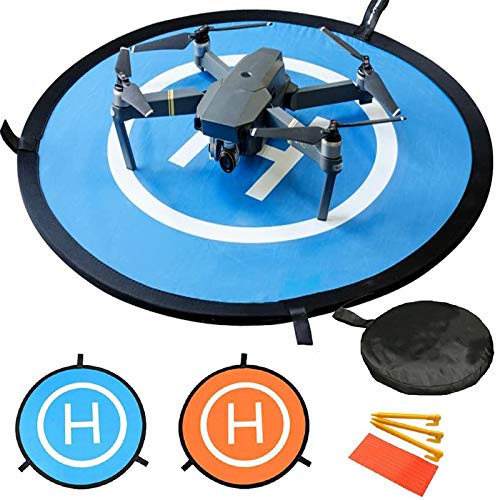
YINGJEE
30 inch waterproof folding landing pad
75 cm, double sided, folds to a disc
First drone, flying from a lawn, park or driveway where the ground is soft or grassy.
Keeps grit out of the motors and gives the downward sensors a clean pattern to read. The cheapest way to stop chewing up your own gimbal.
Hoodman
Hoodman weighted trifold landing pad (LP21)
Weighted edge, no stakes needed
Flying from asphalt, gravel, sand or a client site where you cannot drive stakes into the ground.
Weighted so it stays put without stakes, which matters on asphalt and on a client site where you cannot drive pegs into the ground.
Various
Heavy-duty 4-panel landing pad with ground stakes (48 in)
48 in, four locking panels, stake kit included
Mapping or inspection operators launching a heavier aircraft repeatedly from the same rough site over a full day.
A larger stake-down pad holds flat in real wind and gives a bigger, cleaner reference for downward sensors on a heavier airframe. Buy this for repeat commercial launches from dirt, gravel or a job site, not for a single sub-250 g aircraft flown twice a month.
Prices are approximate and change constantly. Links are affiliate links: we earn a commission if you buy, at no extra cost to you.
The expert-tier stake-down pad above is deliberately not a catalog item on this site because the best option changes by supplier faster than a fixed recommendation stays accurate, so the link goes to a scoped search rather than one fixed product. If you are a casual flyer launching a sub-250 g mini from your own yard a few times a month, skip this tier entirely. The extra bulk, weight in a field bag and setup time buys you nothing that the 30 inch waterproof folding landing pad does not already solve, and a stake kit is one more thing to lose in the grass.
Landing pad sizes and when each one makes sense
Pad size should track aircraft footprint and how forgiving your landings are, not the price tag of the drone. A tight, well-practised landing on a 249 g mini fits comfortably inside a 24 in circle. A less confident landing, a heavier aircraft with wider prop clearance, or landing in a crosswind all argue for more margin.
| Pad size | Typical material | Holds without stakes | Best matched to | Approximate price |
|---|---|---|---|---|
| 24 to 30 in folding disc | Coated nylon, double sided | Calm air only | Sub-250 g minis, backyard and park flying | $12 to $18 |
| 30 to 36 in weighted trifold | Reinforced fabric, weighted hem | Light to moderate wind | Mid-weight camera drones, asphalt and rooftops | $35 to $45 |
| 40 to 48 in stake-down panel | Heavy vinyl or ripstop, locking panels | Moderate to strong wind with stakes driven | Repeat commercial launches, mapping and inspection | $35 to $60 |
| 60 in and larger helipad style | Heavy vinyl, high-visibility markings | Strong wind with a full stake kit | Enterprise operators, fixed job sites, training grounds | $80 and up |
What to check about the launch spot before you unfold the pad
A pad fixes the surface directly under the aircraft, but it does not fix what is underneath the pad. Large metal objects distort a magnetometer reading badly enough to trigger a compass warning before takeoff, and the usual culprits are rebar-reinforced concrete, a manhole cover, a parked vehicle, a steel roof deck, or a chain-link fence closer than a few feet. Walk the launch area and check for those before choosing where the pad goes, not after the aircraft is already refusing to arm. Our compass and IMU calibration guide covers how to read that warning and when a recalibration, rather than a new spot, is the fix.
The pad should also be part of the routine you run every single flight, not a special-occasion accessory. Our preflight checklist treats a clear, contained launch surface as one line item among several, alongside battery voltage, prop condition and a visual scan of the flight path, because a good habit built around one small accessory is worth more than remembering to use it occasionally.
Sand, snow and water launches deserve special mention
A pad earns its price fastest at the beach, in snow, or beside water, which is also where a lot of scenic flying happens. Fine dry sand is abrasive and gets pulled directly into motor bearings by downwash, and a soaked or salt-contaminated motor is a far more expensive repair than a fifteen dollar pad. Snow has almost no visual texture for a downward sensor to read, which is exactly the condition where a printed pad target helps most, and it also keeps the aircraft's landing gear out of slush that will melt into the airframe. Flying near open water raises its own separate set of concerns beyond just the landing surface, covered in full in our flying near water guide.
How much wind can a landing pad actually take before it fails?
Every fabric pad has a practical wind ceiling, and it is lower than most pilots assume. A lightweight unweighted disc like the cheapest 24 in pads on the market starts lifting a corner somewhere around 8 to 10 mph of sustained wind, well below what most airframes still fly comfortably in. A weighted trifold pad, because its own mass resists the same gust, typically holds flat to somewhere around 15 to 20 mph before an edge starts to flutter, which is roughly the same range where a light sub-250 g aircraft is already working hard to hold position. A staked panel pad is the only style rated to hold through genuinely strong wind, because the stakes anchor it to the ground rather than relying on the pad's own weight, and that is exactly why commercial operators standardise on stake-down pads for exposed job sites rather than trusting a trifold pad to hold all day.
A folded or curled pad edge during a landing is a real hazard, not just an inconvenience. Landing gear catching a lifted corner can tip a light aircraft onto its side after touchdown, which is how a gimbal that survived the actual landing gets damaged afterward on the ground. If you are flying in wind that is already testing the aircraft's own limits, either weight down the far corners of the pad with something on hand, such as a rock or a full battery case, or skip the pad for that landing and choose the cleanest bare patch of ground available instead.
Pad material and how long each style actually lasts
Cheap coated nylon discs are the most common material at the low end, and they hold up fine against UV and moisture but are the first to develop pinhole tears at the fold creases after repeated use, usually somewhere in the range of a season or two of regular folding. Reinforced fabric trifold pads with a stitched, weighted hem last noticeably longer at the fold lines because the seam itself is under less repeated stress, and most owner reports put a well cared for trifold pad at three or more seasons before the fabric starts to visibly thin. Heavy vinyl stake-down panels are built for daily commercial abuse and are the most durable material of the three, but they are also the least forgiving to store since the panels do not compress the way a folding fabric pad does.
Buying tips
- Buy the size up if you are not confident yet. A pad you occasionally miss is worse than no pad, because a corner or a curled edge under one leg of the landing gear can tip a light aircraft. New pilots do better with a 30 in pad than a 24 in one.
- Weighted or stake-down beats a plain lightweight disc for anything other than a calm lawn. The cheapest folding pads are genuinely fine in dead calm air and genuinely frustrating the moment a breeze picks up a corner mid-landing.
- Check the fold pattern before you buy. A trifold pad folds down small and fits in a side pocket of a case like the Hard case for Mini 3 and Mini 4 Pro. A rigid stake-down panel does not fold at all and needs its own bag or a rolled tube in the vehicle.
- Wipe it down and let it dry before folding it away. A pad packed away wet grows mildew inside the folds within a week, and a pad with grit ground into the seams from repeated folding stops folding flat within a season.
- Bright colour and a printed centre target help more than they look like they should. They make the aircraft easier to spot from a distance during landing and give a vision-sensor equipped drone a clean reference to lock onto during descent.
If you are assembling a full field kit rather than buying one item at a time, the best drone cases roundup covers where a folded pad actually fits alongside the aircraft, and operators running the same commercial site repeatedly should read the commercial mapping build guide for how a stake-down pad fits into a full day of repeat launches.
Questions people ask
+ Do I actually need a landing pad for a small drone?
Not strictly, but it solves two real problems cheaply. A pad keeps loose grass, sand and grit out of the motor bells and gimbal during takeoff and landing, and it gives downward vision sensors a flat, high-contrast surface to read instead of moving grass or rippled water. For a sub-250 g aircraft like a DJI Neo or Mini 4K, a fifteen dollar pad pays for itself the first time it saves a motor from swallowing a blade of dry grass.
+ What size landing pad should I buy?
Match the pad to the aircraft, not the other way around. A 30 in pad such as the landing pad reviewed here comfortably covers a sub-250 g mini or a mid-weight camera drone with room to correct a slightly off-centre landing. Heavier aircraft, or anyone launching repeatedly from a windy job site, benefit from a 40 to 48 in pad with a locking or weighted edge so wind cannot fold a corner under the aircraft during touchdown.
+ Do weighted pads actually stay put without stakes?
In light to moderate wind, yes. A weighted trifold pad like the Hoodman LP21 uses its own edge weight rather than ground stakes, so it holds flat on asphalt, a rooftop, or a client site where driving pegs into the surface is not allowed. In sustained wind above roughly 15 to 20 mph, any lightweight pad benefits from an extra tie-down point or a stake kit, since a corner lifting during a landing is worse than having no pad at all.
+ Can a landing pad interfere with GPS or compass calibration?
A fabric pad itself will not interfere with GPS or magnetometer readings. The risk is what is under it: rebar-reinforced concrete, a metal manhole cover, a vehicle roof or a steel deck can distort the compass and trigger a warning before takeoff. Choose a launch spot away from large metal structures first, then use the pad on top of it. See our compass and IMU calibration guide for how to recognise and clear that warning.
+ Does a landing pad help with downward obstacle sensing?
Yes, especially on aircraft that use vision sensors to hold position and cushion the final descent. Those sensors work by tracking visual texture on the ground, and a plain, evenly lit pad with a clear centre marking gives them a much easier target than moving grass, glare off wet pavement, or a plain snow surface with almost no texture at all. Pilots flying in snow or over water report the most noticeable improvement from adding a pad.
+ Is a landing pad worth it for FPV freestyle quads?
Less so for a hand-launched, hand-caught freestyle quad that rarely touches the ground under its own power. It matters more for a GPS-equipped cinewhoop or long-range build that lands itself, and for keeping a pit area organised at a group flying field where several pilots are swapping packs on the ground between packs.