Best Drones Under 250 Grams in 2026
Everything here exists to answer one question: what stays under the 250 gram registration line, and what do you give up to get there?
Researched from published specifications and verified owner reviews · updated 2026
The short answer
The DJI Mini 4 Pro weighs 249 g fully loaded and stays under the FAA's 250 g registration threshold while still packing omnidirectional obstacle sensing.
If avoiding FAA recreational registration is the deciding factor in your purchase, the DJI Mini 4 Pro Fly More Combo (RC 2) is the aircraft to look at first. It weighs 249 g at takeoff with the battery and propellers fitted, one gram under the 250 g threshold, while still carrying omnidirectional obstacle sensing and a screen-equipped controller, features normally reserved for aircraft that do require registration. It is the most capable airframe currently built to stay under the line.

DJI
DJI Mini 4 Pro Fly More Combo (RC 2)
4K/60 HDR, omnidirectional sensing, 3 batteries
249 g at takeoff with omnidirectional sensing and three batteries, a feature set normally found only on aircraft that require registration.
Prices move constantly. We earn a commission if you buy through these links, at no extra cost to you.
Why does 250 grams matter more than any other spec on this page?
The 250 g figure is not a marketing number, it is a specific line drawn by the FAA. Any aircraft weighing 250 g (0.55 lb) or more at takeoff, counting the battery, propellers, stickers, filters and anything else bolted on, must be registered with the FAA and marked with the registration number before a recreational flyer can legally fly it. Anything flown under Part 107 for work must be registered regardless of weight, so this entire page speaks to recreational flyers specifically. Cross that line recreationally without registering and you are flying an unregistered aircraft, which carries real penalties.
That single number reshapes an entire buying decision. It is why manufacturers engineer aircraft to land at 248 g or 249 g rather than 245 g or 260 g: every gram spent on a bigger sensor, a stronger frame or a longer-range antenna is a gram taken directly from that budget. Every aircraft on this page is a study in what a manufacturer chose to sacrifice, and what it chose to protect, to stay under that number.
What does staying under 250 grams actually cost you?
Two things, consistently, across every sub-250 g aircraft on the market: sensor size and wind resistance. A larger camera sensor needs a larger, heavier lens assembly and gimbal to move it, which is weight a sub-250 g airframe cannot spend. That is why the DJI Air 3S (RC-N3), at 724 g and well outside the scope of this page, carries a 1-inch main sensor plus a second telephoto lens, while sub-250 g aircraft have historically been limited to smaller sensors, a gap the DJI Mini 5 Pro closes but does not fully erase given its lighter overall airframe.
Wind resistance follows the same physics. A lighter aircraft is pushed around by gusts more than a heavier one with the same motor power, which is why sub-250 g drones are generally rated for lower maximum wind speeds than their 700 g class counterparts. This is not a flaw in the sub-250 g aircraft; it is the direct, unavoidable trade for the weight savings that remove the registration requirement. Check your specific aircraft's wind rating and use our weight and registration calculator before flying in anything beyond a light breeze.
What you do not give up is nearly as important. Every drone on this page still includes GPS position hold, return to home, and in most cases a genuine 3-axis mechanical gimbal. The DJI Mini 4K and DJI Flip both shoot stabilized 4K video from a sub-250 g airframe, a feature set that would have required a much heavier aircraft only a few years ago. The compromise is narrower than it used to be.
Which sub-250 gram aircraft fits your priority: price, image quality, or features?
Beginner, best value and expert sub-250 g drones
All three stay under the 250 g line. What changes is how much camera and sensing they pack into that budget.

Holy Stone
Holy Stone HS175G
4K EIS, GPS return to home, 2 batteries
Buyer who wants GPS hold and a return-to-home under the 250 g line for the lowest possible price.
GPS hold and return to home at the bottom of the market. The camera is electronically stabilised rather than gimballed, so treat the footage as a bonus and the flight training as the point.
DJI
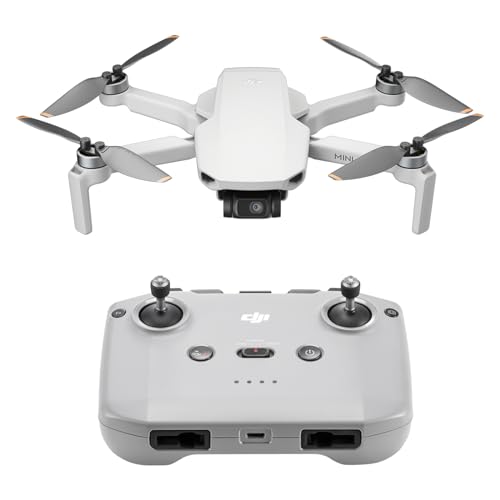
DJI Mini 4K
4K/30, 3-axis gimbal, 31 min rated
Buyer who wants a real gimbal and clean 4K video while still staying under 250 g.
Sits under the 250 g line, so recreational flying needs no aircraft registration. 4K video on a real 3-axis gimbal and a 31 minute rated battery make it the cheapest way to learn without fighting the aircraft.
DJI
DJI Mini 4 Pro Fly More Combo (RC 2)
4K/60 HDR, omnidirectional sensing, 3 batteries
Buyer who needs omnidirectional sensing and three batteries without crossing into registration.
Three batteries, a screen-equipped controller and omnidirectional obstacle sensing in a 249 g airframe. The most capable aircraft that still ducks the recreational registration threshold.
Prices are approximate and change constantly. Links are affiliate links: we earn a commission if you buy, at no extra cost to you.
The Holy Stone HS175G is the entry point specifically because it treats the registration question and the price question the same way: keep both as low as possible. At 249 g with electronically stabilized 4K and GPS return to home, it is the cheapest way to get a compliant, no-paperwork aircraft with usable footage. The camera is the part you give up first at this tier, not the compliance.
The DJI Mini 4K is the best-value tier because it is the lightest aircraft on this list that still carries a true 3-axis mechanical gimbal rather than electronic stabilization, at 248 g. That two-gram margin below the line is tight, which matters if you plan to add an ND filter later; check the accessory's added weight before you fit it.
The DJI Mini 4 Pro Fly More Combo (RC 2) is the expert tier, and it is not the right pick for someone who only cares about staying under 250 g cheaply. Its price, close to $1,299 for the Fly More Combo, buys omnidirectional sensing and three batteries that a casual flyer focused purely on avoiding registration will not use enough to justify. Buy it because you want the capability, not because you want to avoid paperwork; the Holy Stone HS175G does that for a fraction of the price.
Sub-250 gram drone weight and margin comparison
| Drone | Takeoff weight | Margin to 250 g | Camera | Price |
|---|---|---|---|---|
| Potensic ATOM SE | 245 g | 5 g | 4K EIS, brushless | $195 |
| Holy Stone HS175G | 249 g | 1 g | 4K EIS | $190 |
| DJI Mini 4K | 248 g | 2 g | 4K/30, full gimbal | $269 |
| DJI Mini 4 Pro Fly More Combo (RC 2) | 249 g | 1 g | 4K/60 HDR, omnidirectional sensing | $1,299 (combo) |
| DJI Neo 2 | under 250 g | Not published, verify before fitting accessories | 4K, obstacle sensing | $259 |
| DJI Flip | under 250 g | Not published, verify before fitting accessories | 4K/60, full gimbal, guarded props | $349 |
Where a manufacturer publishes an exact takeoff weight, the margin column shows exactly how little room is left before an accessory crosses the line. A 1 g margin, which describes both the Holy Stone HS175G and the DJI Mini 4 Pro Fly More Combo (RC 2), means essentially any add-on, an ND filter, a strobe, even a branded skin with adhesive backing, has a real chance of tipping the aircraft to 250 g. Weigh the complete, accessorized aircraft on a kitchen scale before your first flight if you plan to add anything at all.
What should you check before fitting an accessory to a sub-250 gram drone?
Every accessory adds weight, and on an airframe with a 1 or 2 g margin, that math matters more than it looks like it should. ND filters typically add a small amount and are usually safe on aircraft with several grams of margin, but should be weighed on anything closer to the line. Extended-capacity batteries are the biggest risk: DJI's own extended pack for the Mini series is documented to push total weight over 250 g, which changes the registration answer the moment it is fitted. Propeller guards add real weight for a real safety benefit, which is worth the trade indoors even if it means registering the aircraft.
The honest approach is to weigh the aircraft in its actual flying configuration, not its box-spec configuration, and to re-weigh it any time you change what is attached. Our weight and registration calculator walks through exactly this, adding each accessory's typical weight to a base airframe so you can see the running total before you buy anything.
How does the 250 gram line compare to other countries' thresholds?
The 250 g figure is specific to the United States and the FAA. It is not a universal aeromodelling standard, and pilots who travel or import gear from other regions should not assume it carries over. The United Kingdom's Civil Aviation Authority uses a similar sub-250 g exemption for its own operator registration scheme, so most of the aircraft on this page happen to qualify there too, but the surrounding rules around flyer IDs and remote pilot competency differ enough that the exemption is not a simple copy-paste of the US rule.
The European Union's EASA framework takes a different approach entirely, sorting aircraft into weight-based classes with C0 covering under 250 g specifically, which again lines up numerically with the aircraft recommended here, but EASA class marking requirements and the open category's A1, A2 and A3 subcategories layer additional rules on top of weight alone. Canada sets its own basic and advanced operations split around a 250 g threshold as well, while Australia's excluded category threshold sits at 250 g too, though its sub-rules again diverge from the FAA's. The number 250 g shows up repeatedly worldwide, which is not a coincidence, but treating it as one universal rule instead of several similar-looking national rules is exactly the kind of assumption that gets a traveling pilot in trouble. See our registration thresholds by country reference for the specifics before flying outside the United States.
How did we verify these weight figures without weighing every aircraft ourselves?
We do not fly or physically weigh review units, and we say so plainly rather than implying otherwise. Every weight figure on this page is pulled from manufacturer published specifications, which are the same figures the FAA expects a pilot to rely on for the registration decision. Where a manufacturer's published weight is a range or has been reported inconsistently across markets, verified owner reviews and community measurements are used to flag the discrepancy rather than picking whichever number is more flattering.
Buying tips specific to staying under the registration line
Buy the base kit, not the combo, if the combo bundles an extended battery rather than a second standard one; extended packs are the single most common way a compliant aircraft becomes a non-compliant one after purchase. Read the fine print on any battery upgrade before buying it separately later. Keep the manufacturer's spec sheet or a screenshot of it on your phone, since that documentation is what you would show if your aircraft's compliance were ever questioned.
If you add an ND filter, prop guard or any sticker or label with real adhesive mass, weigh the complete aircraft afterward on a small kitchen or postal scale rather than trusting the accessory's own listed weight, since manufacturer accessory weights are not always as carefully verified as the aircraft's own spec sheet. Review our full registration thresholds by country chart if you travel internationally with a sub-250 g aircraft, since the 250 g line is a US figure and other countries set their own thresholds, sometimes lower.
If your main question is simply "what should my first drone be" rather than specifically "what stays under 250 grams," our broader guide to the best beginner drones ranks aircraft on ease of learning and crash resistance, with weight as only one factor among several. And if lowest total out-the-door cost, not weight, is the deciding factor, see our guide to the best beginner drones on a budget, which ranks every option by all-in price instead.
Finally, remember that staying under 250 g removes exactly one requirement: recreational registration. It does not remove the requirement to pass TRUST, it does not remove Remote ID compliance for the aircraft, and it does not remove airspace authorization requirements in controlled airspace. See our sub-250 g versus heavier drone comparison for the full picture beyond just the registration question.
Questions people ask
+ What is the exact FAA weight limit for a drone to skip registration?
The threshold is 250 g, which is 0.55 lb, measured at takeoff with everything attached: battery, propeller guards, filters, anything bolted on. A recreational flyer whose aircraft weighs under that number does not need to register it with the FAA. The moment an accessory pushes total weight to 250 g or above, registration and external marking become required before the next flight.
+ Does adding a filter or prop guard push a sub-250 g drone over the line?
It can. Aircraft like the DJI Mini 4K ship at 248 g, which leaves only about 2 g of margin before an accessory tips the total to 250 g. A magnetic ND filter or a snap-on prop guard typically adds several grams, which is often enough by itself. Always weigh the aircraft with every accessory attached before assuming it stays under the line.
+ Do sub-250 g drones still need to follow Remote ID and TRUST rules?
Yes. Staying under 250 g only removes the registration requirement for recreational flyers; it does not exempt the aircraft from Remote ID or the pilot from the free TRUST test. Every recreational flyer, regardless of aircraft weight, must pass TRUST and fly under the recreational rules, and Remote ID compliance is required for the aircraft itself unless flying only inside an approved FRIA.
+ What do you give up by staying under 250 g compared to a heavier drone?
Mainly sensor size and wind resistance. Sub-250 g airframes are physically too light to carry the larger sensors and reinforced frames found on 700 g class aircraft like the DJI Air 3S, so image quality and stability in gusty conditions both take a step down. The trade-off buys a lighter, cheaper, no-registration aircraft, which is the right trade for most recreational flyers.
+ Is the DJI Mini 5 Pro really under 250 g with a 1-inch sensor?
Yes, DJI specifically engineered the Mini 5 Pro to carry a 1-inch CMOS sensor, a size previously found only on heavier aircraft, while keeping total takeoff weight under the 250 g registration threshold. That makes it the current answer for buyers who want meaningfully better image quality than the Mini 4K without accepting the registration and higher price of the Air 3S class.
+ If a drone weighs exactly 249 g, does it need to be registered?
No. The FAA threshold is 250 g and above, so an aircraft weighing 249 g at takeoff with everything attached falls just under the line and does not require recreational registration. That single gram is why manufacturers like DJI list several aircraft at exactly 249 g rather than rounding to 250 g, since it is the difference between needing paperwork and not.