Registration thresholds by country
Six jurisdictions, six different answers, and one rule that holds everywhere: check the local authority.
Researched from published specifications and verified owner reviews · updated 2026
The short answer
Weight thresholds vary and so do the obligations attached to them. The United States requires registration at 250 g or more for recreational flying and at any weight under Part 107. The EU uses open, specific and certified categories with A1, A2 and A3 subcategories. The United Kingdom and Canada run their own registration and competency schemes, Japan uses a 100 g threshold, and Australia keys requirements to whether flying is recreational or commercial. No registration transfers across a border.
Drone rules are national, and the most common mistake travellers make is assuming that a familiar number carries across a border. It does not. Even where two countries both use a 250 g threshold, what that threshold triggers, whether a competency test is required alongside it, and whether a camera changes the answer are all decided separately.
This chart is a starting point for research, not an answer. Every row should send you to the named authority. Nothing here is legal advice, and drone regulation moves faster than almost any other area of aviation law.
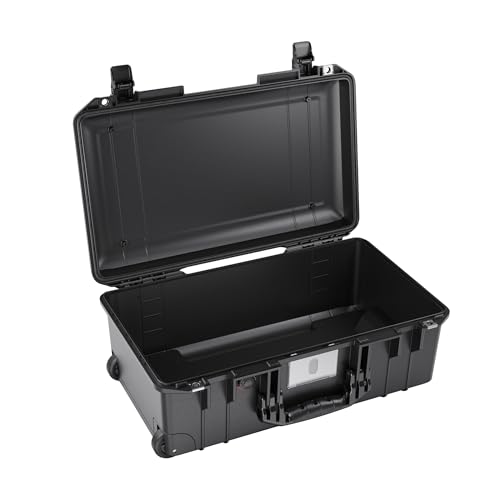
Pelican
Pelican Air 1535 case (no foam)
Carry-on size, IP67, no foam
A carry-on sized watertight case is the practical half of flying abroad, because flight packs generally must travel in the cabin rather than in checked baggage and airlines enforce that inconsistently. A case that fits an overhead locker and takes cut foam lets one kit survive several airframes and several airlines.
Prices move constantly. We earn a commission if you buy through these links, at no extra cost to you.
The comparison
| Jurisdiction | Registration threshold | Pilot competency | Authority to check |
|---|---|---|---|
| United States | 250 g recreational, any weight under Part 107 | TRUST recreational, Part 107 certificate commercial | FAA |
| European Union | Operator registration keyed to weight and to whether a sensor is carried | Online training and test for A1 and A3, further exam for A2 | EASA and the national authority |
| United Kingdom | Operator ID and flyer ID, keyed to weight and to camera | Flyer ID test required at and above the threshold | Civil Aviation Authority |
| Canada | 250 g and above must be registered and marked | Basic or advanced operations certificate by exam | Transport Canada |
| Australia | Keyed to recreational versus commercial rather than weight alone | Accreditation or remote pilot licence depending on the operation | CASA |
| Japan | 100 g and above, notably lower than most | Registration plus remote identification requirements | MLIT |
United States
Two paths. Recreational flying under the limited recreational exception requires the free TRUST test, registration at 250 g or more, Remote ID compliance, visual line of sight, a 400 foot ceiling in uncontrolled airspace and prior authorization in controlled airspace. Commercial flying requires a Part 107 Remote Pilot Certificate and registration at any weight.
The distinguishing feature of the American system compared with the European one is that it sorts by purpose rather than by risk. Whether you need a certificate depends on why you are flying, not on how close to people the aircraft will be. Full detail is on the rules hub and the quick reference.
European Union
The EU framework sorts operations into open, specific and certified categories by risk. Most consumer flying falls in the open category, which is subdivided into A1, A2 and A3 depending on how close to uninvolved people the aircraft may operate. Which subcategory an aircraft can be flown in depends on its class mark and its weight, and pilots complete online training and a test for A1 and A3 with a further examination required for A2.
Operator registration is separate from pilot competency and is generally required above a weight threshold or where the aircraft carries a camera or comparable sensor, which is a privacy-driven provision rather than a safety-driven one. Registration is done in one member state and is recognised across the union, which is a genuine improvement on per-country schemes.
United Kingdom
The United Kingdom operates a two-part scheme. An Operator ID identifies the person responsible for the aircraft and is displayed on it. A Flyer ID demonstrates that the person flying has passed a competency test. Which of the two you need depends on the weight of the aircraft and whether it carries a camera, and many people need both.
The operating rules broadly resemble the EU open category structure, with distances from people and buildings that scale with the aircraft class and weight. Check the Civil Aviation Authority directly, since the details have been revised more than once since the framework was introduced.
Canada
Aircraft weighing 250 g up to 25 kg must be registered with Transport Canada and marked with the registration number. Pilots hold either a basic or an advanced operations certificate, obtained by online examination, with the advanced certificate required for flying in controlled airspace or close to people, and requiring a flight review in addition to the exam.
The distinction between basic and advanced maps loosely onto the American distinction between recreational and Part 107, but it is drawn by proximity and airspace rather than by purpose, which means a recreational Canadian pilot flying near people may need the higher certificate.
Australia and Japan
Australia through CASA keys requirements primarily to whether flying is recreational or commercial, with accreditation required for some recreational operations and a remote pilot licence for commercial work above certain weights. The standard operating conditions are specific about distance from people, altitude and visual line of sight.
Japan through MLIT uses a notably lower registration threshold of 100 g, along with remote identification requirements and a permission system for operations in populated areas and near airports. The low threshold catches a great many aircraft that would be exempt elsewhere, including some that are marketed internationally on the strength of being registration-free.
What always travels with you, and what never does
Never: your registration or certificate. An FAA registration number means nothing abroad, and neither does a Part 107 certificate. Plan on registering locally and on satisfying a local competency requirement.
Never: your assumptions about airspace. Airspace structures, notification systems and authorization mechanisms differ. There is no international LAANC.
Always: the battery rules. Lithium flight packs generally must travel in the cabin rather than in checked baggage, with terminals protected and often with watt-hour limits and quantity limits per passenger. Check the specific airline as well as the general rule, because enforcement varies and a refused bag at the gate ends the trip for the kit. Watt-hour figures for common packs are on the battery spec chart.
Always: the physical care of the kit. A hard case, spare propellers and a USB-C dual-slot SD and microSD card reader ($13) so footage can be offloaded and backed up before the flight home. The full travelling kit is on the field kit guide.
Before you travel with a drone
Check the destination country's aviation authority directly rather than a forum or a summary. Check whether temporary import of a drone is permitted at all, because a small number of countries restrict or prohibit it and confiscation at the border is a real outcome. Check whether a local registration can be completed by a non-resident, since some schemes assume residency. And check whether the specific sites you have in mind are restricted, since national parks, heritage sites and urban centres are commonly off limits regardless of your paperwork.
Everything on this page is researched from published material and is not legal advice, and the thresholds move. For the United States position see the weight classes chart and faa.gov/uas. For anywhere else, the national authority is the only source worth relying on.
Questions people ask
+ Is 250 grams the registration threshold everywhere?
It is common but not universal, and even where the number matches the obligations attached to it differ. The 250 g figure appears in the United States, the EU framework, the United Kingdom and Canada in various forms, while Japan uses 100 g and Australia keys its rules to whether the flight is recreational or commercial rather than to registration by weight alone. Always check the national authority.
+ Does my United States registration work abroad?
No. FAA registration is a United States registration and carries no weight with another country's aviation authority. Flying abroad usually means registering with the local authority, holding whatever local competency certificate applies, and complying with a different set of operating rules. Some countries also restrict or prohibit temporary import of drones.
+ What is the EU open category?
The EU framework sorts operations into open, specific and certified categories by risk rather than by purpose. The open category covers low-risk flying and is split into subcategories A1, A2 and A3 which govern how close to people you may fly, based on the aircraft class mark and its weight. It applies across EU member states, which is a real simplification compared with per-country regimes.
+ Do I need a licence or just a registration?
They are separate things almost everywhere. Registration identifies the aircraft or the operator. A competency certificate, licence or test result establishes that the pilot knows the rules. Many countries require both above a weight threshold, and a few require the competency element even for aircraft too light to need registration if they carry a camera.
+ Does a camera change the requirement?
In several jurisdictions, yes. Some frameworks tie an operator registration requirement to the presence of a camera or other sensor rather than to weight alone, on privacy grounds rather than safety grounds. That is why a very light camera drone can require registration in one country and none in another with a similar weight threshold.
+ How current is this table?
It is researched from published material at the time of writing and drone regulation is among the fastest-moving areas of aviation law. Treat every row as a prompt to check the named authority rather than as an answer. If a flight abroad matters commercially, get the position confirmed locally before you travel with the aircraft.