Best LiPo chargers for FPV drones
A cheap balance charger and a five dollar fireproof bag prevent more real damage, to your packs and to your garage, than any other purchase on this page.
Researched from published specifications and verified owner reviews · updated 2026
The short answer
The ISDT 608AC balance charger at around $65 is the right first real charger for FPV packs, because it delivers 200W across 1 to 6S with per-cell readout and a dedicated storage mode, which is the feature that most extends pack life.
The ISDT 608AC balance charger (200W, 1-6S) is the right first real LiPo charger for anyone flying FPV packs beyond the smallest whoop sizes, delivering 200W across 1S to 6S with individual per-cell readout for around $65. It is the difference between packs that last two full seasons and packs that swell and get thrown out in three months, and it does that job for less than the cost of two replacement packs.

ISDT
ISDT 608AC balance charger (200W, 1-6S)
8A, 200W, AC and DC, XT60
A real balance charger with per-cell readout and a dedicated storage-charge mode, covering 1S to 6S at up to 200W over AC or DC.
Prices move constantly. We earn a commission if you buy through these links, at no extra cost to you.
What actually goes wrong when you skip a real balance charger?
A pack charged without cell-level balancing does not fail immediately, which is exactly why the problem is easy to ignore for months. Cells inside a multi-cell LiPo pack are manufactured close together in capacity but never identical, and every charge and discharge cycle nudges them a fraction further apart in voltage. A balance charger reads each cell individually and tops each one to the correct voltage independently rather than assuming the whole pack is uniform, which is the only thing that stops that drift from compounding.
Storage-charge anything not flying within a few days. Holding packs at roughly 3.8 volts per cell instead of at full 4.2 volt charge for days or weeks at a time is the single change most likely to extend the useful life of a battery you already own, and it costs nothing beyond remembering to set the charger to storage mode instead of full charge mode when you know a pack is going back on a shelf rather than into the air that day.
Left unmanaged, drift eventually produces a pack where one cell sits meaningfully lower than the others, commonly showing up first as flight time that has quietly shortened, then as the aircraft triggering low-voltage warnings earlier than expected, and eventually as a cell that fails outright while the rest of the pack still reads healthy. A six dollar 1-8S LiPo cell checker with low-voltage alarm is the fast way to catch this early: read each cell individually, and a pack showing 3.71, 3.72, 3.70, 3.55 volts across its four cells is telling you plainly that it is close to done, well before it would show up as a problem in flight.
The three tiers
Pick a charger by pack size and how many packs you actually own, not by the highest wattage number on the box. The expert tier below, a parallel charging board, is not useful on its own and is not the right first purchase: it requires a separate balance charger to drive it and only pays off once you own enough matched packs, six or more of the same cell count and chemistry, that charging them one at a time has become a genuine bottleneck.
Beginner, best value and expert
Start with the charger that matches the packs you actually own today, not the packs you might own in a year.
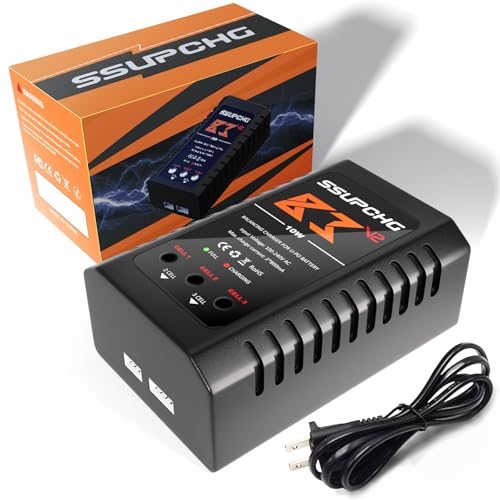
SSUPCHG
SSUPCHG 2S/3S balance charger
2S and 3S, XHR plug
You fly a whoop or micro quad and only ever charge small 2S to 3S packs.
A cheap dedicated charger for the 1S to 3S whoop and micro packs, so your main charger stays free for the big stuff.
ISDT
ISDT 608AC balance charger (200W, 1-6S)
8A, 200W, AC and DC, XT60
You fly FPV freestyle on real LiPo packs and need a proper balance charger.
A real balance charger with storage-charge and per-cell readout. If you fly LiPo packs, this is the difference between packs that last two seasons and packs that swell in three months.

Walfront
XT30 and XT60 parallel charging board (2-6S)
2-6S, XT30 and XT60 ports
You already own a balance charger and want to charge a whole field bag of packs at once.
Charges several matched packs at once from one balance charger. Only parallel packs of the same chemistry, cell count and similar state of charge.
Prices are approximate and change constantly. Links are affiliate links: we earn a commission if you buy, at no extra cost to you.
The SSUPCHG 2S/3S balance charger, at around $17, is the beginner pick because it is a cheap dedicated charger scoped to 2S and 3S packs with an XHR plug, exactly what a whoop or micro quad pilot needs and nothing more. The ISDT 608AC balance charger (200W, 1-6S) is the best-value pick because it covers the full 1S to 6S range a growing FPV pilot will eventually own, from whoop packs up through full 6S freestyle packs, on one charger. The XT30 and XT60 parallel charging board (2-6S), at around $23, is the expert pick because it multiplies the output of a charger you already own across several matched packs at once, which only makes sense once your pack count has grown past what charging individually can keep up with.
How does parallel charging actually work, and when should you avoid it?
A parallel charging board ties the positive and negative leads of several packs together electrically, so a single balance charger output effectively sees one large pack instead of several small ones, charging all of them at the same time. This is a genuine time saver for a field bag of six 6S packs that would otherwise mean six sequential charge cycles, and the XT30 and XT60 parallel charging board (2-6S) covers 2S through 6S packs with both XT30 and XT60 ports to match whatever connector your packs use.
The rule that makes this safe is strict and worth repeating: only parallel packs of the same cell count, the same chemistry, and a similar state of charge. Connecting a 4S pack alongside a 6S pack, or a nearly empty pack alongside a nearly full one, creates an uncontrolled current flow between the packs themselves before the charger even gets involved, which is a real fire risk rather than a minor inefficiency. If you are not confident every pack going on the board matches on all three counts, charge them individually instead.
How fast does a LiPo pack actually charge?
Charge time comes down to two numbers: the pack's capacity in amp-hours, and the current the charger delivers, itself limited by the pack's own maximum charge rate. A 1300 mAh pack rated for 1C charging accepts roughly 1.3 amps, which means a full charge from empty takes close to an hour regardless of how powerful the charger is capable of, because the pack itself is the limiting factor, not the charger. A charger like the ISDT 608AC balance charger (200W, 1-6S) that can push 8 amps only helps once you are charging a pack rated to accept that much current, or several smaller packs in parallel that collectively add up to it.
This is the detail that trips up a lot of new owners: buying a 200 watt charger does not make a single small pack charge in minutes if the pack's own C rating caps the usable current far below what the charger could otherwise deliver. Matching charger capability to actual pack count and size, rather than buying the highest wattage number available, is what determines whether a charger is genuinely useful or mostly unused headroom. The charge time calculator works this out directly from your pack capacity, C rating and charger current, which is a faster path to a real number than doing the arithmetic by hand every time you add a pack to the fleet.
Signs your charger, not your pack, is the problem
A charger that reports a full charge in an unusually short time compared to its own past behavior is worth suspecting before you suspect the pack. Genuine capacity loss in a pack happens gradually over dozens of cycles, not suddenly between one charge and the next, so an abrupt change is more often a sign the charger's current sensing or balance port connection has degraded than a sign the pack failed overnight. Loose balance connectors, in particular, are a common failure point on budget chargers and can cause a charger to report a false balance completion while one cell is still meaningfully under-charged.
A charger that runs noticeably hot to the touch during a normal charge, beyond what its fan or heatsink can keep comfortable, is also worth retiring rather than continuing to trust. Internal component degradation inside a charger is far less discussed than pack degradation, but a charger that has quietly become less accurate over years of use can mask a genuinely unhealthy pack behind readings that look fine, which defeats the entire purpose of owning a balance charger in the first place.
Setting up a charging station that does not become a fire hazard
A dedicated charging area, even a simple one, is worth setting up once you own more than two or three packs. Use a hard, non-flammable surface such as a metal cart, a concrete garage floor or a ceramic tile counter, positioned away from anything flammable including curtains, paper and stored fuel. Keep a fire extinguisher rated for the job nearby, and know before you need it that a standard water or foam extinguisher does not put out a lithium fire the way it does an ordinary combustion fire; sand or a purpose-made lithium fire extinguisher is the correct tool, and simply letting a contained lithium fire burn itself out in a safe, isolated spot is sometimes the realistic answer for a small pack.
Charge inside a Zeee fireproof LiPo charging bags (2 pack) even in a dedicated area, since the bag is designed to contain and vent a runaway cell rather than let it spread to whatever the pack happens to be sitting on. This is not redundant caution, it is two independent layers of protection: the non-flammable surface protects the surroundings if a fire does start, and the fireproof bag reduces the odds it spreads far enough to reach that surrounding at all.
How we chose these picks
We do not fly review units for this page. Charger wattage, cell count support and mode options come from manufacturer specification sheets, the chemistry and voltage figures come from standard published LiPo chemistry data, and notes on real-world reliability and failure modes come from verified owner reviews and community reports read in volume rather than from our own use. Prices are the observed listing price at time of writing and move constantly.
LiPo chargers and safety gear compared
| Item | Price | Cell range | Best for |
|---|---|---|---|
| SSUPCHG 2S/3S balance charger | $17 | 2S, 3S | Whoop and micro packs |
| ISDT 608AC balance charger (200W, 1-6S) | $65 | 1S to 6S | Main FPV charger for most pilots |
| XT30 and XT60 parallel charging board (2-6S) | $23 | 2S to 6S | Charging matched packs in bulk |
| 1-8S LiPo cell checker with low-voltage alarm | $6 | 1S to 8S | Per-cell voltage and health check |
| Zeee fireproof LiPo charging bags (2 pack) | $15 | n/a | Fireproof charging and short-term storage |
| Zeee fireproof LiPo storage box | $14 | n/a | Rigid fireproof storage for packs not in use |
Buying tips
Charge and store every LiPo pack inside a fireproof container, always, with no exceptions for a pack that looks fine. A Zeee fireproof LiPo charging bags (2 pack) is the right choice while a pack is actively charging or between a flight and its next charge, and a rigid Zeee fireproof LiPo storage box is the right choice for the packs sitting in the garage between sessions. Neither is a substitute for the other: bags are for charging, a box is for the packs you are not using today.
Let a pack cool to roughly room temperature after a flight before putting it on charge. A pack warm from flying stresses its cells more under a fresh charge cycle than a cool one does, and it also makes it harder to notice a pack that starts warming up abnormally partway through charging, which is one of the earlier and more reliable warning signs of a developing internal problem.
Never leave a pack charging unattended, and never charge on a flammable surface such as a bed, carpet or wooden desk. Lithium polymer chemistry carries a real thermal runaway risk if a cell is damaged internally, and that risk exists whether the pack looks intact or not. Charging on a hard, non-flammable surface with the charger in sight is the cheapest insurance in the entire hobby.
Check the balance connector, not just the main power lead, before every charge. The main connector, commonly XT30 or XT60 for FPV packs, carries the bulk charging current, while the smaller balance connector, often labeled JST-XH, is what lets the charger read and correct each cell individually. A pack charged through only its main connector with the balance lead unplugged or damaged still charges, but it charges as one undifferentiated block rather than being balanced cell by cell, which silently undoes the entire benefit of owning a balance charger in the first place.
Match your charger's output current setting to your pack's actual charge rating, printed on the pack as a C rating alongside its capacity. Charging faster than a pack is rated for shortens its life and increases the chance of a thermal event; a 1300 mAh pack rated at 1C should be charged at roughly 1.3 amps, not at the charger's maximum output just because the charger allows it.
If your charger supports both AC and DC input, know when each makes sense. AC charging from a wall outlet is the simplest option at home. DC charging from a 12 volt source, including a portable power station, typically charges faster and is the more practical option in the field, where a field charging power source becomes part of the same kit as the charger itself.
For the full voltage-by-charge-state numbers referenced throughout this page, 4.2 volts full, 3.8 volts storage, never below 3.5 volts under load and never below 3.0 volts resting, see the LiPo voltage reference chart. The broader set of storage and handling habits, including how long a pack can safely sit at storage charge and when to retire one outright, is covered in LiPo battery care and storage. If you are deciding how many packs to actually own for your flying pattern, the batteries themselves are ranked separately in best drone batteries, and the soldering tools worth owning alongside a charger, for pack repair and connector work, are in best FPV tools and soldering gear.
Questions people ask
+ What is a balance charger and why do I need one for FPV packs?
A balance charger monitors and charges each individual cell inside a multi-cell LiPo pack, rather than treating the pack as one big battery. Cells in a pack drift apart in voltage slightly with use, and without balance charging that drift compounds over time until one cell is meaningfully weaker than the others, which shows up as reduced flight time and, eventually, a cell that fails well before the rest of the pack does.
+ What does storage charge mean and what voltage should I use?
Storage charge is a partial charge level, roughly 3.8 volts per cell, that LiPo packs should be held at when not being flown within the next few days. It sits meaningfully below full charge, 4.2 volts per cell, and holding packs there instead of at full charge is the single biggest factor in how long a pack lasts before its capacity noticeably degrades. Most balance chargers, including the ISDT 608AC, have a dedicated storage mode that does this automatically.
+ Is it safe to charge multiple LiPo packs at once with a parallel board?
Yes, provided every pack on the board matches in cell count, chemistry and is at a similar state of charge before you connect them. A parallel charging board ties several packs together electrically so one balance charger output charges all of them simultaneously, which is a real time saver for anyone managing a field bag of six or more packs, but mixing a nearly empty pack with a nearly full one on the same board is not something the board can safely correct for.
+ How can I tell if a LiPo pack is too damaged to charge?
Any visible puffing or swelling in the casing, a punctured or torn outer wrap exposing the foil cells beneath, a burnt smell, or a pack that was in a hard crash and shows physical deformation are all reasons to retire the pack rather than charge it. A cheap cell checker reading one cell noticeably lower than the others, more than roughly 0.1 volts off, is also a warning sign worth taking seriously even without visible damage.
+ What is the difference between AC and DC charging on a balance charger?
AC charging plugs the charger directly into a wall outlet, while DC charging feeds the charger from a separate DC power supply or a car battery, typically at 12 volts, and usually charges faster because it is not limited by the charger converting AC power internally. A charger like the ISDT 608AC that supports both gives you wall-outlet convenience at home and faster charging in the field from a portable power station or a vehicle.
+ How long should I let a warm LiPo pack cool before charging it?
Let a pack that is warm from flying cool to roughly room temperature before putting it on charge, which usually takes fifteen to thirty minutes depending on ambient conditions. Charging a warm pack immediately after flight stresses the cells more than charging a cool one does, and it also makes it harder to notice a pack that is warming up abnormally during the charge itself, which is one of the clearer warning signs of a developing problem.